Home - Barrier-free access
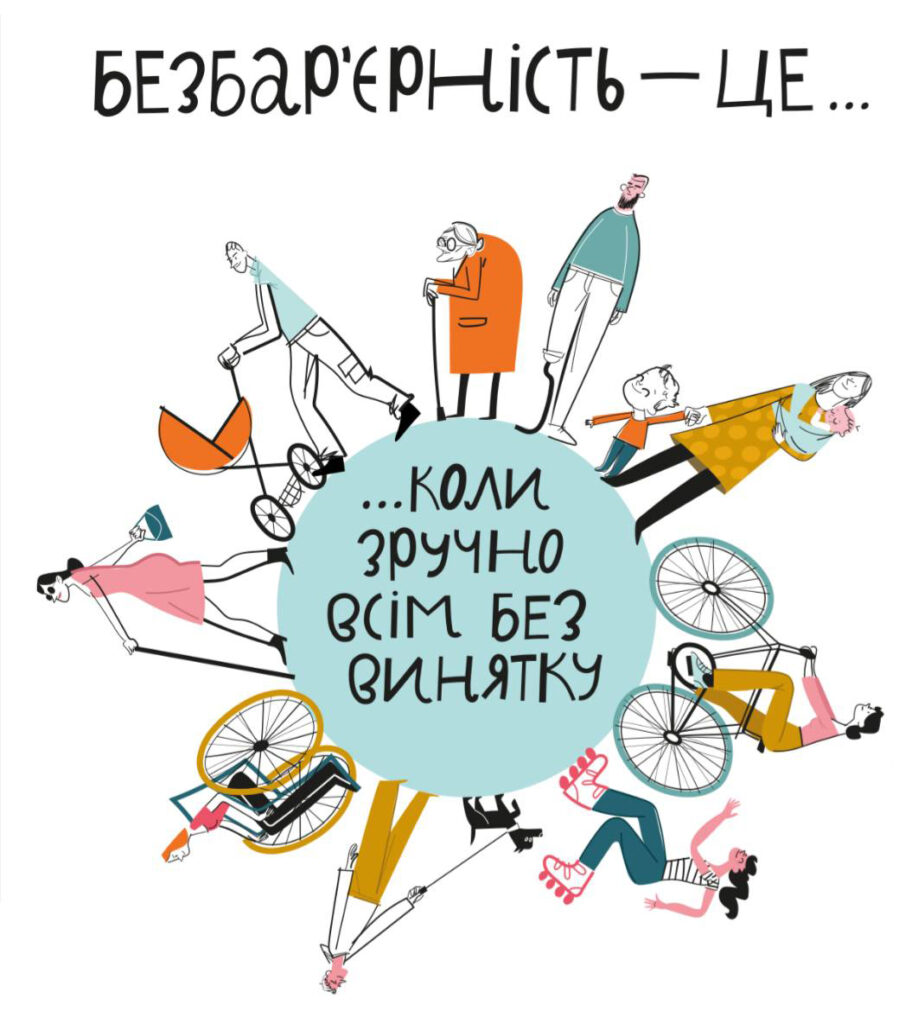
Barrier-free access - is a concept that envisages the creation of conditions in which all people, regardless of their physical, sensory, intellectual or other characteristics, have equal access to various aspects of social life. It is a way to create a comfortable environment where there are no restrictions and everyone has the opportunity to realise their potential.
This is when everyone, regardless of age, disability, gender or other characteristics, can:
It is also about convenience, respect and consideration of the needs of everyone, including people with limited mobility. These are people who experience difficulties in moving independently, receiving services, obtaining necessary information or navigating in space.
In today's world, it is important that everyone - regardless of age, health or life circumstances - has the opportunity to study, work, dream and fulfil themselves without hindrance.
Barrier-free accessibility starts with simple speeches:
Ukraine has developed National strategy for creating a barrier-free space until 2030, which defines new standards of accessibility and inclusion, providing for the creation of barrier-free space in all spheres of life and for all social groups, including people with disabilities, the elderly, youth, women, parents of young children and children with disabilities.
https://zakon.rada.gov.ua/laws/show/366-2021-%D1%80#Text
The document provides for the creation of a barrier-free space in Ukraine in six main areas:
Social and civic inclusion, which provides equal opportunities for all people and social groups to participate in the life of communities and the state.
Educational accessibility - creating equal opportunities and free access to education, including lifelong learning.
Economic inclusion - providing conditions and opportunities for employment and entrepreneurship for young people, women, the elderly, people with disabilities, etc.
Information accessibility - conditions under which people, regardless of their functional impairments or communication capabilities, have access to information in different formats and using technologies that take into account their needs and capabilities.
Physical accessibility - creating an environment in which public buildings and public spaces, transport and services are physically accessible to all social groups.
Digital inclusion - ensuring access to information, communication, public and other services online for all social groups, including the elderly, people with disabilities, people living in rural areas, etc.
On the portal of public services Action. in December 2022, a section was created «Diya.Bezbarunnist», which aims to simplify communication between people and the state. It implements the concept of barrier-free access as a new social norm, where everyone has access to public services, education, employment and a comfortable life. The section provides accessible information about state public services and contains useful materials and instructions to help you understand public services.
The main directions of «Action.Barrier-free»:
Practical advice on communication ethics and tolerance can be found in «Barrier-free guide». This is the first Ukrainian guide to barrier-free communication, which appeared in 2021. It explains what barriers, stereotypes, inclusion, engagement, non-discrimination, tolerance, acceptance, accessibility, gender equality, and the rules of correct language are.
The separate structural unit “Vocational Education” of the Research Institute of Applied Information Technologies ensures educational barrier-free access, providing equal access to educational materials and services for all students (applicants for education), including people with disabilities. We introduce inclusive methods into the educational process, adapting educational programmes and technologies to the individual needs of each student (applicant for education).
Our materials and services meet the requirements of accessibility, which allows all students (learners) to acquire the necessary knowledge and skills without restrictions.
We create a comfortable and supportive learning environment that encourages the development and achievement of learning goals for everyone. Our team is constantly improving our educational products, applying the latest approaches and technologies to ensure inclusion. We also collaborate with experts in the field of inclusive education to implement best practices and solutions.
Our goal is to create an education system where every student can realise their potential regardless of physical or other limitations. For us, educational accessibility is not only a requirement of the times, but also our principle that defines all aspects of our activities. In this way, we contribute to the development of a society where education is accessible to all.
Regulatory framework for barrier-free access
If you have any questions, please do not hesitate to contact us.
We will answer you as soon as possible!
The creation of the information and production system for providing individuals with data on education, IIS OSVITA, began in 1996 to meet the requirements of Cabinet of Ministers of Ukraine Resolution No. 704 "On Improving the Protection of Documents on Education" of 29 June 1996.
The Centre for International Projects "Euroeducation" was established in 2003 on the initiative and with the support of the Research Institute of Applied Information Technologies of the Cybernetic Centre of the National Academy of Sciences of Ukraine.
The electronic student/student card is an element of the information and analytical system for accounting and reimbursement of benefits to students of higher education institutions and students of vocational schools.
The Supplement to the Diploma of Higher Education is introduced pursuant to the Order of the Cabinet of Ministers of Ukraine No. 655 of 4 September 2013 "On Amendments to the Resolution of the Cabinet of Ministers of Ukraine No. 1260 of 12 November 1997".
"Abiturient" will prepare you for the external independent testing in the main 8 subjects through distance learning courses. Professional methodologists have developed tests for you according to the requirements of the programme.
All services of the school information space "Moya Osvita" contribute to the improvement of the effectiveness of communication between teachers and parents, which affects the improvement of the educational process. The information is transferred from the School system.
The information and analytical system for monitoring education was developed by the Research Institute to improve the learning process, strengthen control over educational, administrative and economic activities both within the educational institution itself and by the district and city departments of education and science.
As a manufacturer of state-standard educational documents with 15 years of experience, the Research Institute of Applied Information Technologies expresses its respect and offers cooperation in this area!
The document is an element of the information and analytical system for accounting and reimbursement of benefits to students of higher education institutions and students of vocational schools. The information carrier is an embedded microprocessor (chip module).
A personalised document, protected against forgery, confirming the identity of the student, the educational institution in which he/she is studying, and the locality in which the educational institution is located.
The company has its own powerful production base, which allows it to produce plastic cards, print on dense and heavy materials, and provide rapid printing services.
Trainings are an integral part of supporting users of software developed by the Research Institute of Applied Information Technologies.
A software and technology complex for managing the educational process of an educational institution, designed to organise the work of methodologists and reduce the amount of paperwork.
Automates the work of the admissions committee and ensures the storage of personal files of applicants and information on admission results for use in the institution's departments.
A unified database is being created to control the campus housing stock and facilities, the procedure for accommodating students, postgraduates, doctoral students and outsiders, and the issuance and accounting of accommodation documents.
Student and teacher e-cabinets are designed to simplify processes directly related to students, their workload and academic performance, and to automate processes related to information and scheduling.
Software and technology complex for the effective management of a secondary school. Work with up-to-date and historical information on students, form various selections from student lists - by lessons, classes, etc.
An integrated solution based on STOP-Net ACS and the School automated system. Organisation of a reliable automated access control regime to the territory of the educational institution. Implementation of multifunctional contactless student cards based on Mifare Plus technology.
It is an integral part of the automated system "School" and can also be used as a separate software product for conducting intermediate and final tests of pupils, students, employees and other persons.